
A home battery sounds simple until the first real sizing question comes up: should it keep the whole house running, or just the refrigerator, Wi-Fi, lights, and a few outlets? That difference can turn a manageable project into an oversized one fast. According to the U.S. Energy Information Administration, the average American home uses hundreds of kilowatt-hours per month, but backup planning is usually about the loads that matter most during a specific window.
Start With the Job, Not the Battery
A battery energy storage system stores electricity from solar panels or the grid and releases it later when the home needs it. For homeowners, that usually means one of three goals:
- Using more rooftop solar instead of exporting it
- Keeping essential loads on during an outage
- Shifting energy use away from expensive evening utility rates
Each goal points to a different battery size. A home focused on solar self-consumption may only need enough storage to cover evening use. A home in a storm-prone area may care more about keeping heat, refrigeration, communications, and medical equipment online.
The mistake is sizing a battery around the entire electric bill. That number includes water heating, HVAC, laundry, cooking, and other loads that may not all need backup at once.
Think in Critical Loads
Critical loads are the circuits that should keep running when the grid goes down. A typical list might include a refrigerator, freezer, internet router, lighting, garage door opener, sump pump, and a few kitchen outlets.
A small system can often cover those loads for a short outage. A larger system may support air conditioning, well pumps, or electric cooking, but those appliances raise both capacity and power requirements. Capacity is measured in kilowatt-hours, while power output is measured in kilowatts. One determines how long the battery lasts; the other determines what can run at the same time.
NREL research on solar-plus-storage resilience has emphasized that backup value depends heavily on load selection and outage duration. In plain language, a well-planned smaller system can sometimes feel more useful than a large system with no load strategy.
Where All-in-One Systems Fit
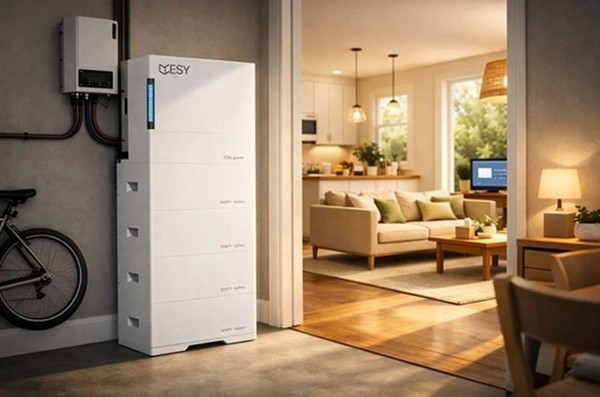
All-in-one home energy storage combines the inverter, battery, and controls in one coordinated system. That can make planning easier because the storage, conversion, and monitoring components are designed to work together.
For example, ESYsunhome lists single-phase residential systems such as HM5 and HM6 in the 5-6 kW range with 5-30 kWh battery configurations, while HM10 and HM12 move into higher power territory for homes with larger backup needs. Homeowners comparing options can review ESYsunhome’s home solar battery storage solution when evaluating solar self-use, backup, and EV charging in one household energy plan.
A Practical Sizing Conversation
A useful sizing conversation usually starts with four questions:
| Question | Why it matters |
|---|---|
| What must stay on? | Defines critical loads |
| How long should backup last? | Sets storage capacity |
| Will solar recharge the battery? | Changes outage endurance |
| Are there high-power appliances? | Affects inverter size |
A battery sized for eight hours of essentials is very different from one sized for two days of whole-home operation. Neither is wrong. They solve different problems.
The Bottom Line
A home battery should be sized around behavior, outage risk, and the circuits that actually matter. A system that keeps a house comfortable and functional during the most likely outage is often a better investment than one sized around every possible appliance.
For homeowners comparing integrated solar, storage, and backup options, ESYsunhome’s residential page is a useful place to see how all-in-one systems are framed for real household energy needs.
Price publication: 10.00 USD
Total: 10.00 USD